

Dry Suit Myths
Commom Dry Suit Myths By: John Boyer,
Diving
Unlimited International
In the drysuit business just
as in scuba diving in general we are constantly plagued by false impressions and
stories that have been handed down from one person to another, most of which
have been embellished upon by the storytellers whose only error is the desire to
make a story more interesting.This article will attempt to
address the most common myths regarding diving in drysuits and allow you, the
potential purchaser, to make your decision with more correct information than
the "hearsay" attitudes that plague most things in which there are few experts.
DRYSUITS KEEP YOU WARM!
For the most part this is an incorrect statement. The drysuit itself, with the exception of the "foam neoprene" suits whose thermal protection is quickly lost due to compression during descent, provide little or no thermal protection. The purpose of the drysuit is simply to keep the diver dry. The garment we wear under the suit, commonly referred to as "divewear insulation," is what is responsible for keeping the diver warm. The warmth accomplished as a result of wearing divewear insulation is a function of the ability of the material to trap and hold air between the fibers. No garment, including a heavy ski parka, has the ability to insulate as a result of the material. Its ability to insulate is in its relative ability to trap air between the fibers. Some fibers are much more efficient at trapping air than others. Some fibers, such as Type "B" Thinsulate™ Insulation (100% polypropylene micro fiber*) have the ability to resist absorption of water and, therefore, are more efficient as a dive wear insulation fabric. The ability to change the configuration of the dive wear insulation on each dive, taking the water temperature, the diver’s personal metabolism, and the anticipated activity (more activity generally requires less insulation) of the dive is one of the most basic advantages of diving in a drysuit. In a 7mm wetsuit the diver has 7mm of neoprene on each dive, regardless of the conditions. On most occasions 7mm is either too much or too little. Also, foam neoprene provides more insulation in shallow water and less in deeper water.
YOU WILL HAVE AN UNCONTROLLED, FEET FIRST ASCENT TO THE SURFACE!
This is probably the most
common fear expressed by non-drysuit divers. Nearly every diver who has
expressed this fear claims to have had or has seen someone have this problem.
When questioned in more detail about the actual sequence of events, most of
these stories are actually in the "a friend had it happen to them" or "I heard
it from a diver I know" category. On only one or two occasions have I actually
talked to someone who claims they have had this happen to them. On those rare
occasions the person frankly admitted they were at fault since they improperly
operated the equipment or didn’t take the time to be trained in the proper
procedures.First, if properly operated,
the amount of air required to obtain the "loft" of the undergarment (loft is the
term used to describe the process of making air available so that the fabric can
"trap the air" between the fibers) is very minimal.Proper weighting in a drysuit
is achieved by the diver entering water too deep to stand up in, holding a
normal breath, with no air in the BCD and minimal residual air in the drysuit.
Remaining motionless, the diver would float at eyebrow level. A diver weighted
in this manner would float at about mouth level if a lung full of air was taken
in and would slowly descend if the "normal" breath were exhaled. This is neutral
buoyancy (In a normal recreational equipment configuration an additional five
pounds of weight should be added to compensate for the air that will be cast off
during the dive. If an 80 cu. ft. aluminum tank were totally drained the weight
difference would actually be closer to six pounds.) If the diver simply adds air
to the drysuit during descent in the amount necessary to maintain a constant
volume, the ancillary benefit is the maintenance of neutrality with just the air
added to the suit. When dealing with a large volume, double tanks or other heavy
equipment a different technique is required.The size of the bubble of air
necessary to achieve the state described in the paragraph above would, if the
diver were to raise their right arm toward the surface in a head up position,
begin at the wrist seal and continue down the raised arm about four to nine
inches toward the elbow. The "roving" bubble is always found at the high point
in the suit. This bubble needs to be kept to a minimum. The phrase "a pint (of
air) is a pound (of buoyancy) the world around" means that every extra pint of
air in the suit requires a pound on the weight system. Excess air in the suit
does not increase the insulation value of the dive wear. Proper weighting is
important to keep the bubble small.The bubble described above
could not, under most circumstances, cause the diver any concern. Also, since
the diver is neutrally buoyant it doesn’t matter what attitude (head up, butt
up, feet up or belly up) they are in. Neutrality is neutrality and nothing
during the dive changes the laws of physics and allows the attitude to change
the buoyancy of the diver. Only in extremely shallow water (15 feet or less)
would there be a significant change of volume due to a diver changing from
horizontal to vertical.A properly trained diver is
taught to respond to an "over inflation" emergency in the very unlikely event it
should happen. First, most modern drysuits are equipped with adjustable dump
valves that will expel air as quickly as the inflator will put air into the suit
when the exhaust valve is positioned at the highest point in the suit. Second,
it is a simple procedure to disconnect the power inflator should it get stuck in
the open position (Simpler in most brands than disconnecting a BCD power
inflator. The DUI hose has a large flange that makes it easy to grasp, even with
gloves, and disconnect.) Third, and by no means less important, is the fact that
a diver trained properly in a drysuit is taught to recover from a (falsely
induced) feet up, positively buoyant situation. Recovery is accomplished within
a minimum of vertical movement.One suit manufacturer has
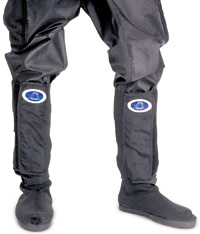
installed exhaust valves in the ankles of the suit to combat this "mythical"
problem. All this does is perpetuate and give credence to a problem that really
doesn’t exist. Additionally, the diver with these valves loses the air in the
suit (which, as an ancillary benefit, provides neutral buoyancy) each time their
feet get above the level position. This requires constant replacement of the air
in the suit to maintain constant volume, avoid squeeze and achieve neutral
buoyancy. The important point is that by installing these valves, that
manufacturer lends credence (by putting equipment on the suit designed to combat
the problem) to the myth of an uncontrolled feet first ascent. Also worthy of
note is that the valve is positioned high enough on the ankle that a large
bubble would still form in the boots.
DRYSUITS ARE CUMBERSOME AND DIFFICULT
TO DON AND REMOVE
This is probably the easiest
myth to dispel. All a diver has to do is try on a drysuit and the myth is
dispelled.At the entry level, if a
student is allowed to don a modern drysuit immediately after struggling in and
out of a typical wetsuit, the dive student will probably ask to be allowed to
take their course in the drysuit.Almost everyone who has taken
his or her entry-level course in a wetsuit can remember the difficulty in
donning and removing the wetsuit. At consumer shows, when putting people in
drysuits, the most common expression heard is "I didn’t know it would be so easy
and comfortable to get in and out of this thing.
FOAM NEOPRENE NECK
AND WRIST SEALS ARE MUCH BETTER
In some special cases this
statement may be true. As a rule, however, foam neoprene is not the best choice.Many pieces of diving
equipment are designed to fulfill the same objective. In each case, the
determining factors are the pros and cons of each when applied to a specific
situation.The major advantage of foam
neoprene seals is that they are somewhat more durable in regard to abrasion.The negative aspects of foam
neoprene seals, in all applications, make them the poorer choice overall. Foam
neoprene is much more difficult to don and remove due to the thickness of the
rubber and the fact that foam neoprene has a nylon covering on at least one
surface.Foam neoprene is purported to
be warmer than latex. This is only slightly true. If the diver does not descend
then the inherent insulation in foam neoprene is a factor. Since divers do
descend, the compression of foam neoprene negates the insulation. Only because
the material, even when compressed at depth, is thicker is there any insulation
value.Since foam neoprene compresses
at depth, the seal that is water tight on the surface may leak when compressed.
The continuous compression and expansion (descending and ascending) of foam
neoprene are the primary reasons foam neoprene drysuits or wetsuits do not last
as long as Trilaminate or Crushed Neoprene. The same is true with foam neoprene
seals.Foam neoprene has a memory.
This fact is evident even in the instructions furnished with the seals. If the
foam neoprene seal is too tight we suggest the customers "stretch" the seal
(neck) over a scuba cylinder overnight. This actually destroys some of the
closed cells thus permanently rendering the seal larger. If left to compression
and expansion the same thing would happen naturally.High quality latex has very
little memory. It will, after stretching, go back to the original shape more
readily. Since latex is considerably thinner it is more comfortable simply from
a standpoint of bulkiness. If properly maintained, latex will last longer than
foam neoprene that is dived frequently. Proper maintenance includes proper
trimming, (so there are no "saw tooth" edges that lead to tearing) rinsing,
dusting with unscented talcum powder when storing for long periods and storing
in "low ozone" areas.Since latex seals are made in
a cone shape, they are "trimmable" to fit the individual. Care must be exercised
to not trim too much off at one time. The seals have "guide lines" to help in
the trimming process. Only one line should be removed at a time and the seal
should be tried on after each line is trimmed. If unfamiliar with trimming
techniques consult your DUI dealer or call DUI.
DRYSUITS ARE TOO
EXPENSIVE!
The initial up-front cost of
the modern drysuit is somewhat more that the typical wetsuit. Just as in any
investment the price of the item is only one part of the equation. Modern
drysuits, with the exception of foam neoprene suits, will last so much longer
that the effective cost of the suit is much less. Just as with any item that
depreciates, the cost should be divided by the number of uses the item returns.
Dividing the cost of the drysuit by the number of dives a diver will get from
the suit will yield a "cost per dive" figure. In most all cases the "cost per
dive" will be considerably lower in a modern drysuit than a wetsuit (except for
foam neoprene).Even with the above
information the fact remains that the customer has to take a relatively large
sum of money out of their pocket and put it on the counter. Most dealers selling
drysuits have innovative plans available that allow the diver to get into a
drysuit without causing a financial burden.Economics and "just the facts"
don’t take into consideration the increased degree of comfort achieved by the
drysuit diver. Imagine all of the different things in our lives that we could
actually do without but, because we want to be more comfortable, we decide to
obtain the item or convenience. Diving, for most people, is an exhilarating
experience and if those in wetsuits realized how much more enjoyable their dives
would be if they were warm and comfortable most would invest in a drysuit
immediately.Another thing that many people
don’t realize is that if a diver is warm they are much more efficient. Even
those who claim they don’t get cold suffer a decrease of efficiency by losing
body temperature to the environment. In almost every dive accident recorded,
cold can be identified as a factor. The first thing a diver loses as a result of
a drop in body temperature, is mental acuity. The recognition of a potential
problem can go unnoticed because being cold slows the mental process. The second
symptom of temperature drop is the loss of physical dexterity. The ability to
take proper action to avert the results of a problem is lost. Many divers lose
dexterity without even knowing they are being adversely affected by a loss of
temperature.
DRYSUITS ARE FOR
PROFESSIONALS
AND ADVANCED DIVERS ONLY!
People who express this
opinion need only analyze the statement. Of course, those who know most about
diving and who are doing it most frequently will gravitate to the most efficient
and most comfortable way to achieve the desired results. If I wanted to improve
my methods I would first look to see how those who do it best are doing it. The
best reason for professionals or advanced divers to dive in drysuits is that
they know most about it and do it more frequently. An endorsement of this type
by a professional should be viewed as an unquestionable testimony.Simply stated, the fact that
professionals and advanced divers use drysuits is the best reason for all divers
to use drysuits.
IF THE SUIT FLOODS
IT WILL DRAG YOU TO THE BOTTOM!
In the past people were
warned, "never wear hip boots in a boat or around deep water. If you fall in the
boots will fill with water and drag you down." To dispel this myth in training
lifeguards one of the exercises used is to have trainees don hip waders and swim
lengths of the pool. Although the boots make it more difficult to swim
gracefully there is no need for additional effort to remain afloat.If an object displaces an
amount of water weighing more than the object, the item will float. If the item
immersed in water is water the displacement is exactly equal and the result is
neither positive nor negative buoyancy.Recreational divers should
always wear a Buoyancy Compensation Device (BCD). Regardless of the method
employed to maintain temperature equilibrium the BCD would be used for surface
support and in the event of any emergency.
THERE IS NO SUCH
THING AS A DRYSUIT. THE BEST YOU CAN HOPE FOR IS "SEMI-DRY"!
In the past this statement was
more credible than it is today. First, there is no such thing as "semi-dry."
Just as there is no such thing as "semi-pregnant", a person is either dry or
they are wet.Modern drysuits are made to
totally exclude water. If the system is properly operated it will keep the diver
dry. If the suit is poorly maintained, ill fitted, improperly donned or
incorrectly used there is a chance that the user will get wet. In almost every
case where the diver in a drysuit gets wet one of the aforementioned items is at
fault.Proper training, including
donning, diving techniques (including emergency procedures), removing, care and
storing, are all part of the complete package that makes up the responsibilities
when purchasing a drysuit system. It is the responsibility of the person selling
the product to ensure that the purchaser is either qualified to use the
equipment properly or will get instruction in its proper use. It is the
responsibility of the purchaser or user of the drysuit to ensure that they are
properly trained to use the product safely and correctly.
DRYSUITS CAUSE A LOT
MORE DRAG AND REQUIRE A LOT MORE WEIGHT!
The additional drag caused by
the modern drysuit is nearly undetectable. The drag caused by the scuba
equipment itself far outweighs any drag caused by the suit that the typical
diver would be hard-pressed to detect any change. This is not to say that an
expert who is accustomed to swimming in a current would not be able to detect a
difference. More important than the drag in some drysuits, is the fact that the
diver’s "range of motion" is adversely effected.When selecting a drysuit the
purchaser should be asked to perform a series of exercises designed to assess
the ability to perform some simple motions:* raise the leg so that the
foot is level with the knee of the other leg
* perform a "figure four" (such as the figure four used to don fins)
* reach the back of the neck with both hands
* touch hands together stretched overhead
* in a kneeling position, sit back towards the feetThe above "range of motion"
exercises should be performed with the divewear and again with the divewear
insulation and the drysuit together. None of the equipment should impede the
diver’s ability to do the "range of motion" exercises. A high-quality drysuit
will allow the diver to do all of these exercises unencumbered.One of the greatest advantages
to a drysuit is that on each dive the diver is allowed to take into
consideration: 1) temperature of the water 2) the diver’s metabolic rate at the
time of the dive and 3) the rate of exercise performed on this dive. As these
items vary, so does the diver’s ability to vary the divewear insulation under
the drysuit. Generally with a wetsuit the diver is either too warm or too cold.As far as weight is concerned,
the drysuit diver is able to adjust the amount of weight in accordance with
their thermal needs. The more thermal protection they use the more weight is
necessary.It is impossible to generalize
weight requirements. For example, one diver wears twenty pounds of weight with a
6.5 mm wetsuit. In a drysuit, comfortably equipped for temperatures between 50
and 70 degrees F, this diver will use twenty-two pounds of weight. If a vest is
added (giving an additional 5 degrees of warmth) this diver will wear twenty-six
pounds. Due to the wide variation of body composition there is no general rule
of thumb. Each diver must weight themselves according to their needs. However,
to say that a diver needs much more weight with a drysuit is incorrect.
DRYSUITS ARE ONLY
FOR EXTREMELY COLD WATER!
In the entry-level course the
students are taught that water conducts heat 25 times faster than air. This
means that if a body is immersed in water colder than body temperature heat is
being drawn away from the body 25 times faster than if the body were surrounded
by air. In cold climates windows are installed with "twin panes" since it is
generally accepted that a dead air space insulates most efficiently. Household
insulation, cold weather sleeping bags and numerous other heat retention items
base their insulatory value on their ability to trap air.It simply makes better sense
to select the most efficient method to retain heat in any endeavor. Based on
this logic it is easy to conclude: if there is a need for thermal protection
while diving, a drysuit, since air is the insulator, is always a better choice
than a wetsuit.One of the best attributes of
a high quality, well fitted wetsuit is that it excludes water from most of the
body and prevents the "flushing" of water in areas where water is not excluded.
This is more evidence indicating that if the diver totally excludes water from
the system it would be more efficient.Since the divewear the diver
wears under the drysuit provides the thermal protection and the amount of
protection is variable according to the three things mentioned earlier, the
chances of a drysuit diver being uncomfortable are minimized. This is true for
all temperatures of water from ice diving to, in some cases, eighty-degree
water.
DRYSUIT DIVING IS
TOO TECHNICAL
FOR THE RECREATIONAL DIVER!
Early on all scuba diving was
thought to be too complicated for recreational divers. In all facets of scuba
diving the proper procedures must be followed. Drysuit diving is no different.
It is no more or less complicated than diving with a BCD. When the first BCD was
introduced, many people in the dive education community pointed and laughed at
the new divers showing up in BCD’s. Many thought they were cumbersome,
complicated, bulky and dangerous. To introduce them to a new diver would be task
loading and asking for trouble. Today the training organizations all require the
use of a BCD in dive training. Entry level students trained in drysuits tend to
accomplish buoyancy skills with much less trouble and much more accuracy. Divers
trained in drysuits tend to dive more often, take more courses, purchase more
equipment and are less likely to become an "occasional" or "dropout" diver.